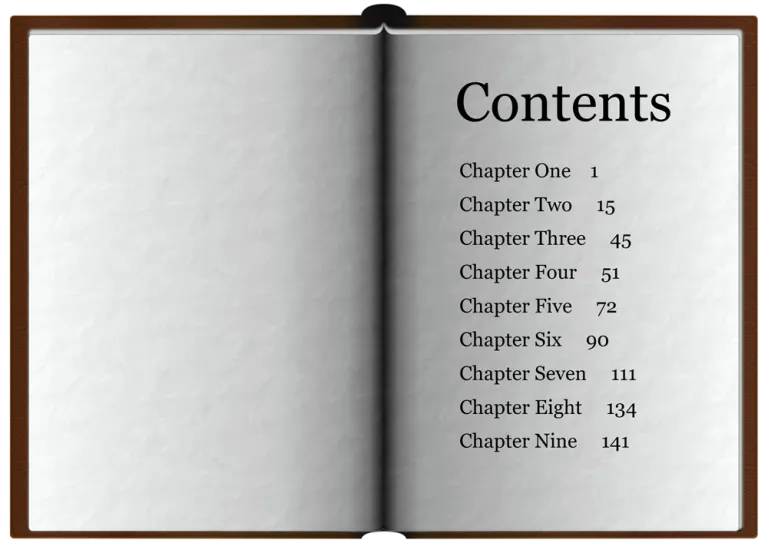



Publishers of e-book and audiobook fiction routinely require a table of contents to aid readers in navigating the chapters, even if the hardcover and paperback editions don’t have one. In e-books, the TOC consists of hyperlinks that jump to coded locations, not to page numbers. Even if an author or publisher decides not to display a contents “page” at the front of an e-book, a table of contents will be generated for the e-book’s menu so readers will still have a way of getting to different sections in the book. Audiobook narrators tend to skip the front matter of novels (other than an epigraph or dedication), but like e-books, audiobooks normally include a contents menu to help readers move to different chapters or other sections in the book.


What are the contents of a book?
Basic parts of a book include front matter (title page, copyright page, dedication, acknowledgments, foreword, table of contents, etc.); body matter (prologue and chapters or other contents); and end matter (bibliography, glossary, index, author biography, etc.).